
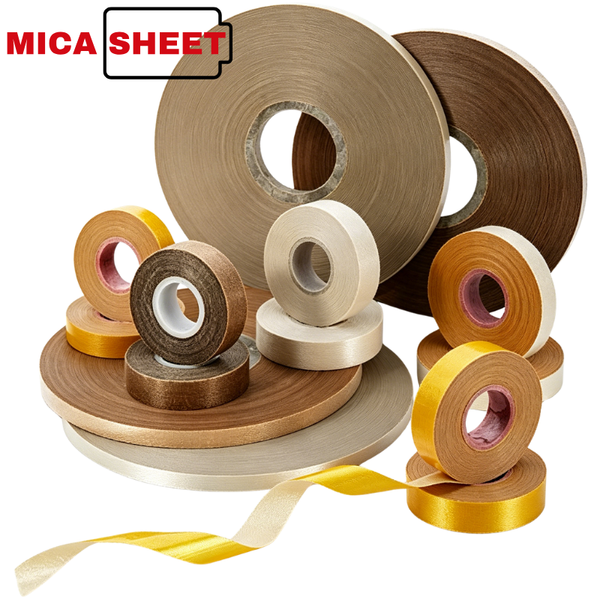
What Is Mica Tape?
Mica tapes act as high-performance electrical insulation materials made from mica paper bonded to a glass-fiber backing. Engineers often impregnate it with heat-resistant epoxy or silicone. This tape delivers robust fire resistance and superior dielectric strength without coatings or fillers.
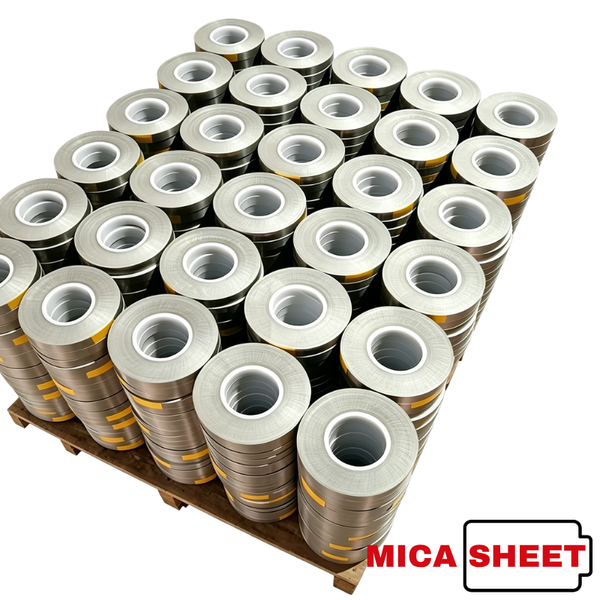
Classification of Mica Tapes
1. By Application
- Motor‑Grade Tape – Coil winders wrap this tape around field and armature slots in large motors. Manufacturers often use single‑ or double‑sided glass cloth to reinforce mica paper epoxy, ensuring strength during VPI (Vacuum Pressure Impregnation) processes and Class F thermal levels (up to 155 °C / 311 °F).
- Cable‑Grade Tape – Cable makers wrap this tape between the copper core and outer sheath to maintain power delivery even during fires.
2. By Structure
- Double‑Sided – Glass cloth on both sides of mica paper. This layout handles wrapping stress and offers balanced strength.
- Single‑Sided – Glass cloth on one side. This format bends more easily while still meeting fire‑safe reinforcements.
- Triple‑Layer (3‑in‑1) – Glass cloth, mica paper, and poly‑film in a sandwich layer. Companies bond this structure with epoxy to boost fire and dielectric endurance.
- Film‑Backed Types – These use plastic film (polyester or polyimide) as the substrate. They add mechanical durability, so operators use them in motors—but never in fire‑rated cables.
3. By Mica Type & Temperature Handling
Here’s how the common mica types compare:
| Mica Type | Temperature Rating | Key Features |
|---|---|---|
| Synthetic Mica Tape | Over 1,000 °C (Class A) | Pure crystals resist breakdown; strong dielectric strength; available in 0.08–0.15 mm thickness, up to 920 mm wide |
| Phlogopite Mica Tape | Stable to ~800 °C under load | Resists corona, acid/alkali, and radiation; tape can withstand 1,000 V at 840 °C for 90 minutes with no failure |
| Muscovite Mica Tape | Stable up to 600 °C | Reliable at normal operating temperatures, but it begins to lose crystalline water around 600 °C, limiting its heat resistance |
Performance of Mica Tapes
- Insulation Reliability — Each layer of mica paper and reinforced glass cloth gives consistently high resistivity. Designers count on it to reduce leakage current and avoid short circuits.
- Fire‑Safe Operation — Synthetic variants withstand flash temperatures well past 1,000 °C. Phlogopite stays stable around 800 °C, while muscovite holds at 600 °C. This fire behavior keeps cables functional during emergencies.
- Mechanical Flexibility — Manufacturers braid or wrap rolls of mica tape with no tearing. Moreover, it fits around tight radii and contours in motor coils and cable joints.
- Chemical Resistance — The epoxy or silicone binders withstand acids, alkalis, solvents, and high humidity without losing insulation quality.
- Dielectric Strength — Mica offers near-zero dielectric loss. Designers use it to meet IEEE‑rated breakdown volt/mm while ensuring Class F voltage endurance.
Key Uses
- Power Systems
- Coil rewind shops use mop rolls of double‑sided tape coupled with VPI epoxy—ideal for motors from Class F stators to high‑power generators.
- Cable manufacturers wrap multi‑core systems where fire‑resistance must meet IEC 60332 or UL 2196. In case of a fire, power flows for a defined duration.
- Electronic Controls and Capacitor Assembly
- Tape wraps around control windings or embedded in capacitor terminals to avoid corona and limit signal distortion.
- Renewable Energy
- Electric Vehicles (EVs): OEMs place phlogopite‑based tape around battery cell terminals and junction boxes to slow thermal runaway in case of fire.
- Wind Turbines: Tape insulates generator coils exposed to harsh, high‑temperature operating cycles.
- Solar PV: Tape either wraps high‑voltage busbars or seals interconnects subject to UV, field moisture, or possible arc faults.
Why Engineers Prefer It
- Consistent Quality: Suppliers meet precise thickness ranges (e.g., 0.08 mm to 0.15 mm) and maintain tight tolerances.
- Easy Installation: Rolls unwind smoothly and contour cleanly. They resist frays even under fast automatic wrapping or manual layering.
- Regulatory Compliance: Tape meets UL‑listed Class F (155 °C) and IEC/ANSI ratings, making it ideal for USA and EU market standards.
- Long-Term Durability: The mica‑glass‑resin structure resists aging under heat and does not evolve gas or smoke during fire — a major safety plus in confined spaces.
✅ Summary
First, designers choose mica tape to combine fire resistance, high dielectric strength, and mechanical flexibility. Then, manufacturers match tape types (single/double‑sided, mica grade) to each use case—whether that’s motors, cables, or electronics. Finally, installers rely on the tape’s easy handling and stable performance to meet code requirements in Western markets. Together, those factors make mica tape a go‑to insulating solution for demanding electrical applications.